Dry needling: what is it and what can you expect?
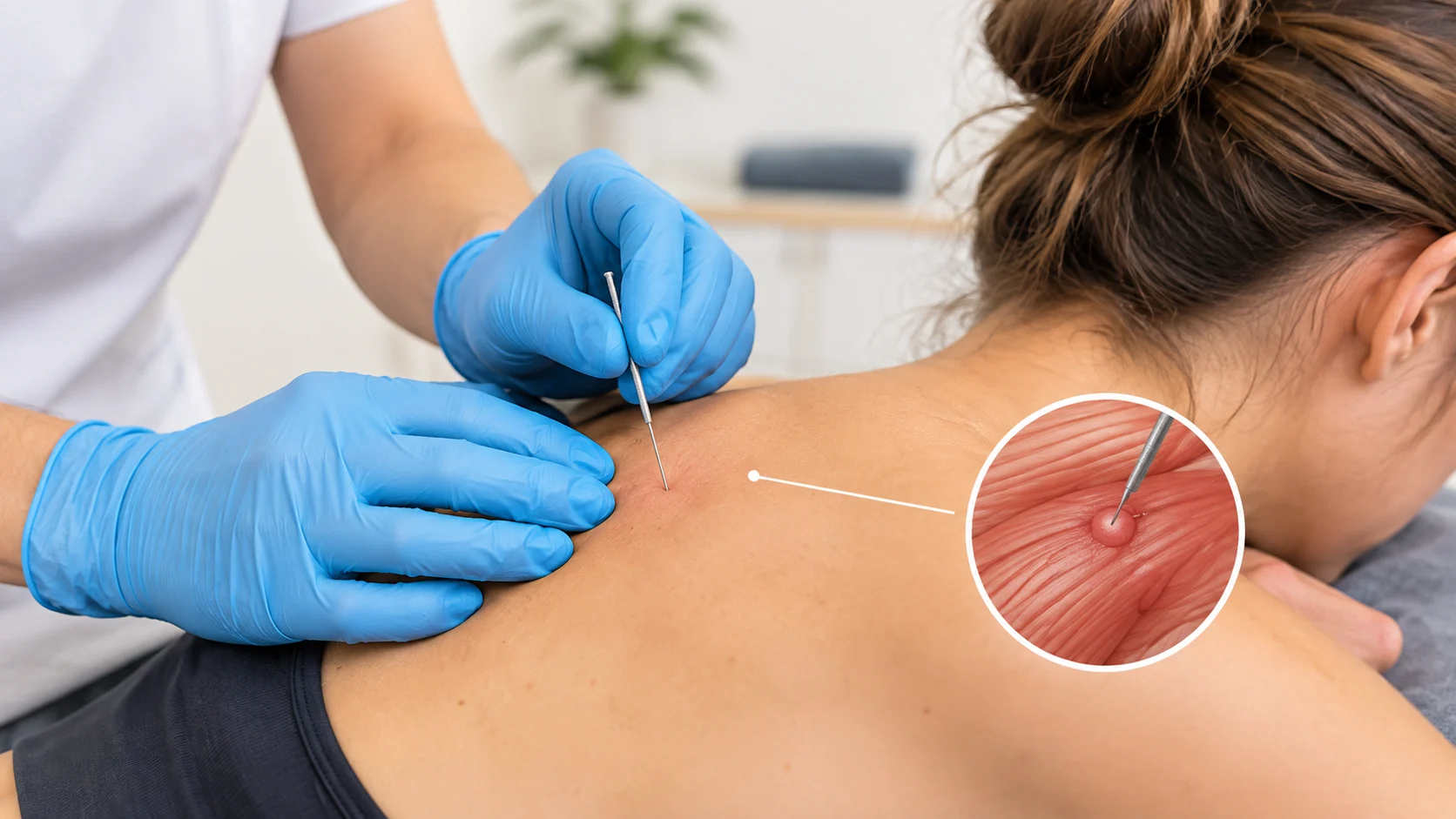
Dry needling is a treatment method in which a specialized physiotherapist uses a thin needle to puncture tense spots in a muscle. The goal is to influence muscle tension, making movement or exercise easier.
The treatment rarely stands alone. During the intake, you discuss your symptoms, the physiotherapist examines how you move, and together you determine whether dry needling fits within your care plan. The nature of the complaint, your health, and the goal of the treatment are taken into account in this process.
What is dry needling and when is it used?
With dry needling, the physiotherapist inserts a targeted needle into a tense spot in a muscle, often referred to as a trigger point. Such a spot can be locally sensitive and cause pain during movement, stretching, or pressure on the muscle. The term 'dry' means that no fluid or medication is injected.
The method can be considered when increased muscle tension plays a recognizable role in your complaint. Think of a stiff neck after working in one position for a long time, a tense calf while building up running, or a sensitive shoulder muscle that restricts movement. However, a single painful spot is not an automatic reason to use acupuncture; it must first be clear whether the muscle is likely contributing to the problem.
A careful choice begins with a discussion about the origin and progression of the complaint and a physical examination of, among other things, movement, muscle function, and tenderness. If strength, joint function, or load plays a greater role, exercise therapy, manual therapy, or the Mulligan Concept may be more appropriate. Dry needling can then be skipped or used as part of a broader treatment plan.
How does a dry needling treatment proceed?
A treatment begins with an examination. The physiotherapist determines which movement triggers your complaint, examines the involved muscles, and discusses what will happen beforehand. You can ask questions and give consent before a needle is used.
Next, you assume a position in which the muscle in question is accessible and as relaxed as possible. The skin is exposed, after which the physiotherapist inserts a thin needle briefly and precisely into the muscle. Sometimes the muscle responds with a brief, involuntary contraction. The needle does not remain in place for a fixed time as standard; the procedure depends on the muscle, your reaction, and the treatment goal.
After needling, the physiotherapist re-tests the relevant movement. This is a concrete check: does turning your neck, lifting your arm, or bearing weight on your leg change, for example? Subsequently, exercise therapy may be necessary to utilize the regained range of motion and to build strength or load-bearing capacity. Simply needling without considering the cause, daily load, and recovery progression is often too narrow an approach.
Does dry needling hurt and what reactions can you feel?
The insertion of the thin needle is experienced differently by different people. You may feel a small prick, while touching a sensitive spot in the muscle can cause a brief, spasmodic or jerky reaction. That moment is usually brief, but your experience determines whether the treatment is well tolerated.
After the treatment, the muscle may feel sensitive, bruised, or fatigued. Movement may also temporarily feel different due to changes in muscle tension. Before needling, discuss any previous reactions to needles, fear, or tendency to faint so that the physiotherapist can adjust the position and approach accordingly. Treatment while lying down may be more sensible, for example, if you experience dizziness from needles.
Pain is not an end in itself. Indicate immediately if a sensation is sharp, unexpected, or difficult to tolerate; the physiotherapist can then stop and reassess. Also contact us if a reaction after the treatment concerns you or clearly increases. A brief evaluation on the same day and at the next appointment helps determine whether a repeat treatment is appropriate.
What expectations can you have of dry needling for muscle complaints?
Do not expect a guaranteed or permanent solution after one treatment. Dry needling may be intended to temporarily make a tense muscle less restrictive, but recovery also depends on the cause, the duration of your symptoms, and how you strain the muscle afterwards.
A useful treatment goal is measurable. For example, choose one movement that is monitored before and after treatment: the distance you turn your head, lifting your arm, or performing a squat. This way, you assess not only whether the muscle feels different, but also whether the change is relevant to your daily activity or sport.
Suppose an athlete constantly tenses the calf after an ankle injury, making push-off more difficult. Dry needling may then be considered to influence muscle tension, followed by exercise therapy aimed at mobility, strength, and a gradual return to load. If the push-off remains unchanged, the care plan must be reviewed rather than automatically repeating the same treatment. Regarding questions about strength, a targeted measurement, such as an isokinetic strength test with Cybex, can provide more information than just the sensation in the muscle.
For which conditions is dry needling suitable and when is it not advisable?
Dry needling may be suitable for muscle complaints where local tension, tenderness, and limited movement occur together. Possible complaint areas include the neck, shoulder, back, arm, hip, thigh, knee area, calf, or foot. However, the location where you feel pain is not automatically the muscle that needs to be treated.
An assessment is particularly relevant for sports injuries and for orthopedic, traumatological, or spine-related complaints. In such cases, joints, tendons, nerves, or recovery after injury may also play a role. First, determine whether muscle-focused treatment is appropriate. For tendon problems, shockwave therapy may sometimes be considered, while ultrasound can be helpful when further tissue examination is appropriate within the physiotherapeutic assessment.
Injecting is not advisable without prior screening. In any case, report medication use, blood clotting problems, pregnancy, infections or skin problems around the injection site, reduced sensitivity, fear of needles, and previous adverse reactions. The physiotherapist will then make one of three choices: treatment, adjusting the approach, or skipping dry needling. Choose exercise therapy or another method when the potential strain does not outweigh the intended benefit.
Checklist for your appointment
Use these 6 points to check whether the treatment carefully aligns with your complaint and treatment goal.
- I can explain when my complaint started and which movements trigger the pain.
- I reported medication use and relevant health problems prior to treatment.
- I know which muscle is treated and why that muscle might be involved in my complaint.
- I have chosen one movement with the physiotherapist that will be tested before and after the treatment.
- I know what reactions I might feel afterwards and when I need to make contact.
- I have discussed which exercise therapy or load progression is needed after the aspiration.
Do you want to know if dry needling is suitable for your muscle complaint? Make an appointment at Fysioplein for an intake in the The Hague, Delft, or Rotterdam region. After the examination, you will determine together with a specialized physiotherapist which approach is appropriate and what place dry needling will have within your care plan.